
Glossary · interior landscaping and plant care
The words of interior plant care, explained.
Thirty-nine terms that interior landscaping and plant service companies use every week — the plants and displays, the planter from the top dressing down, plant health, and the rotations, replacements and reports behind a maintenance contract — each in a sentence or two, and where FolioGreen uses it.
39 terms in four groups
Open a group
Two planters, in section
What sits under the top dressing.
A finished display shows only the plant and its planter. Underneath is how it is grown — dropped in on a riser, or sitting over its own water reservoir. The numbers match the terms below.
39 terms shown
No term matches. Try a shorter word.
Plants and displays
What the plant care company looks after, by kind.
- Interior landscaping
The design, installation and ongoing care of plants inside buildings — offices, hotels, shops and lobbies — by a plant service company, usually under a maintenance contract with the client.
Also called interior plantscaping, interiorscaping, commercial plant services
- Display
In FolioGreen, one planting at a client’s site — a reception planter, a row of planters, a green wall — recorded with its plants and its own care history.
- Plant asset
In FolioGreen, a single plant tracked like an asset: its species, pot size and place, its health over time, and every care action, rotation and replacement it has been through.
- Specimen plant
A single large plant chosen as a feature — a tall palm by reception, a sculpted ficus in an atrium. Often the most valuable plant on a site and the hardest to replace like for like.
- Tabletop and desk plants
Small plants on counters, desks and shelves. There are usually more of them than anything else on a site, and they are the easiest to lose track of when people move them.
- Green wall
Living plants growing in panels or pockets fixed to a wall, usually with their own irrigation. FolioGreen keeps the record of the plants on it: a wall is a display — or one display per section on a large wall.
Also called living wall, vertical garden
- Moss wall
A wall panel of preserved moss. It is no longer living, needs no watering or light, and is cared for by keeping it clean and away from very dry or very humid air.
Also called preserved moss wall
- Seasonal color
Flowering plants — orchids, bromeliads, poinsettias — placed for a season or a few weeks and swapped on a schedule, so a display always has something in bloom.
Also called color program
- Holiday décor
Seasonal decorating — trees, garlands, poinsettias — installed before the holidays and taken down after. Many interior landscaping companies offer it as a seasonal service alongside the maintenance contract.
The planter, inside and out
From the top dressing down to the reservoir.
- Decorative container
The outer container chosen for the interior. Many have no drainage hole, so the plant grows inside it in a grow pot or a liner rather than straight in the container.
Also called planter, cachepot
- Grow pot
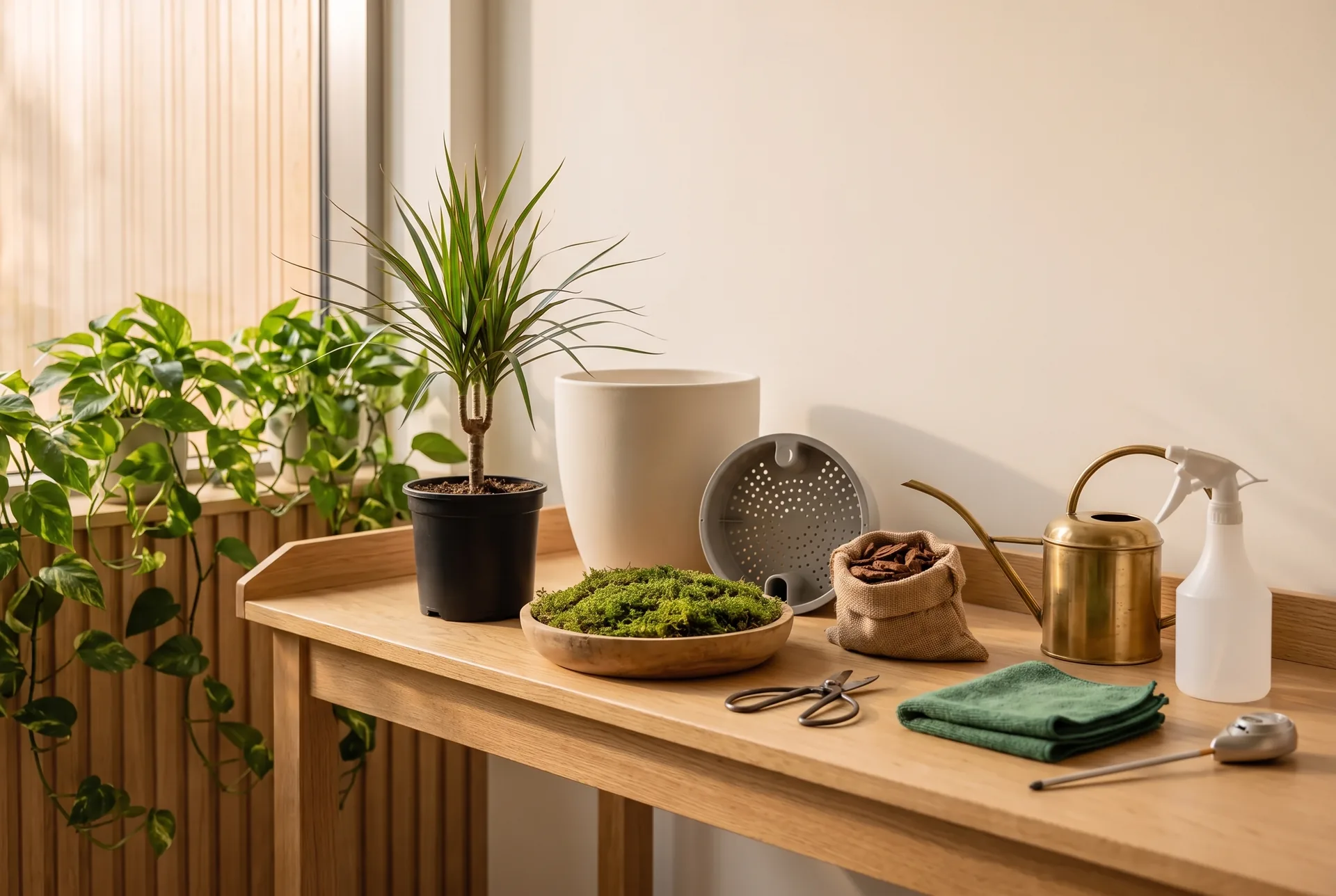
The plain plastic pot the plant was grown in. In a drop-in planting it stays on and stands inside the decorative container.
Also called nursery pot
- Drop-in planting
Setting the plant, still in its grow pot, inside the decorative container. It is quick to rotate or replace without disturbing the roots; any excess water collects below, so the technician checks it.
- Direct planting
Planting straight into a lined container filled with grow medium. It can look fuller, but every rotation or replacement means lifting the roots.
- Riser
Blocks, foam or an upturned pot under the grow pot, lifting it so the plant sits at the right height in the planter.
Also called filler, spacer
- Liner
A waterproof inner layer or insert that protects the decorative container — and the floor beneath it — from water.
- Sub-irrigation
A planter with a water reservoir below the grow medium. Water rises into the root zone through a wick or a column of soil, so plants can go longer between waterings.
Also called self-watering planter
- Water-level indicator
A float in a tube that shows how much water is left in a sub-irrigated planter’s reservoir, so it is read at each visit rather than guessed.
- Fill tube
The tube used to refill a reservoir without wetting the surface of the grow medium.
- Grow medium
What the roots grow in: a soil-based or soilless mix, often with bark or perlite for air and drainage. Some interiors use semi-hydroponic media such as expanded clay.
Also called potting mix
- Top dressing
Moss, bark, pebbles or stone over the surface of the grow medium. It finishes the look and hides the grow pot — and is lifted to check the moisture underneath.
Care and condition
What a technician checks, and what it shows.
- Care visit
One scheduled visit to a site to look after its displays — water, clean, prune, check health, rotate or replace — recorded display by display.
- Watering interval
How often a plant needs water where it stands, set by its species, pot size, light and the season. Overwatering is one of the most common ways interior plants are lost.
- Moisture check
Checking the root zone with a probe or by hand before watering, so water goes where it is needed rather than by the calendar.
Also called soil moisture probe
- Light level
How much usable light a plant gets where it stands, measured with a light meter. Most interiors are far darker than outdoors, so each species is chosen for its spot.
- Acclimatized plant
A plant grown or held under shade before it is installed, so it has adapted to indoor light. It drops fewer leaves after delivery than one moved straight from full sun.
- Health score
In FolioGreen, a plant’s condition on a simple scale, recorded at each care visit and rolled up for each display and site. The labels shown — Thriving, Healthy, Needs attention, Critical — are still being finalised.
- Leaf cleaning
Dusting and wiping leaves so the plant looks fresh and takes in the light it gets. Part of almost every care visit.
- Pruning
Removing yellowing, damaged or leggy growth to keep a plant healthy and the right shape and size for its spot.
- Leaf drop
A plant shedding leaves — often after a move, a change in light, a draft from a door or air-conditioning, or too much or too little water. A signal to record and watch.
- Pest management
Keeping mealybugs, scale insects, spider mites and fungus gnats in check by inspecting, cleaning, isolating affected plants and treating only where needed.
Also called integrated pest management, IPM
Rotations, replacements and records
What moves, and what is kept of it.
- Plant rotation
Taking a plant out of a display — for a season, to recover or for an event — and putting another in its place. FolioGreen is built to record it against the plant, with the reason and the date it is due back.
- Recovery
Taking a struggling plant back to the greenhouse to recover, with a stand-in placed meanwhile, then returning it once it is healthy again.
- Replacement
Swapping a plant that has declined for a new one. Many maintenance contracts include replacements, so each one has a cost to the plant care company and a reason worth recording.
- Guaranteed maintenance
A maintenance contract in which the plant care company replaces any plant that declines, at no extra charge to the client.
Also called full-service contract
- Plant rental
Placing plants at a client’s site for a monthly fee that usually covers their care and replacements, instead of selling them outright. In offices it is often sold as office plant rental and maintenance.
Also called plant leasing; office plant rental and maintenance
- Event staging
Plants placed for a wedding, a launch or a conference for a few days, then collected — recorded as a rotation with a return date.
- Spec against actual
What a display or site should hold under the contract, against what is really there and healthy. A plant missing or failing shows the gap.
Also called specification
- Plant Care Report
In FolioGreen, the monthly or seasonal report a client keeps: how many care visits, how the plants are doing, what was rotated or replaced, photos from before and after, and an opening summary you review and adjust before sending.
- Work Record
In FolioGreen, a job’s own account — the steps your technician logged, photos from before and after, how long the team was there. It is filed with the display’s history and reaches the client only if you decide to share it.
Keep reading
Where these words do their work.
- Every plant on recordOne portfolio holding each client, site, display and plant asset, plus health scores and the Plant Care Report.See the plant portfolio
- Plants in hotelsOrchids at reception, palms in the lobby, and a ballroom that needs twelve palms by Friday.See hotel plant care
- Plants in officesPlanter runs on every floor, a facilities manager checking them, and teams who carry plants off to meetings.See office plant care
Founding access
Be first when FolioGreen opens.
FolioGreen is being shaped around the interior landscaping companies who use these words every day: each plant kept on record, care visits logged display by display, rotations and replacements tracked, and a Plant Care Report for every client. You’ll hear about founding-customer access and the launch — nothing else.
Launching with a 14-day free trial. No card needed.
Coming soon Request founding access