
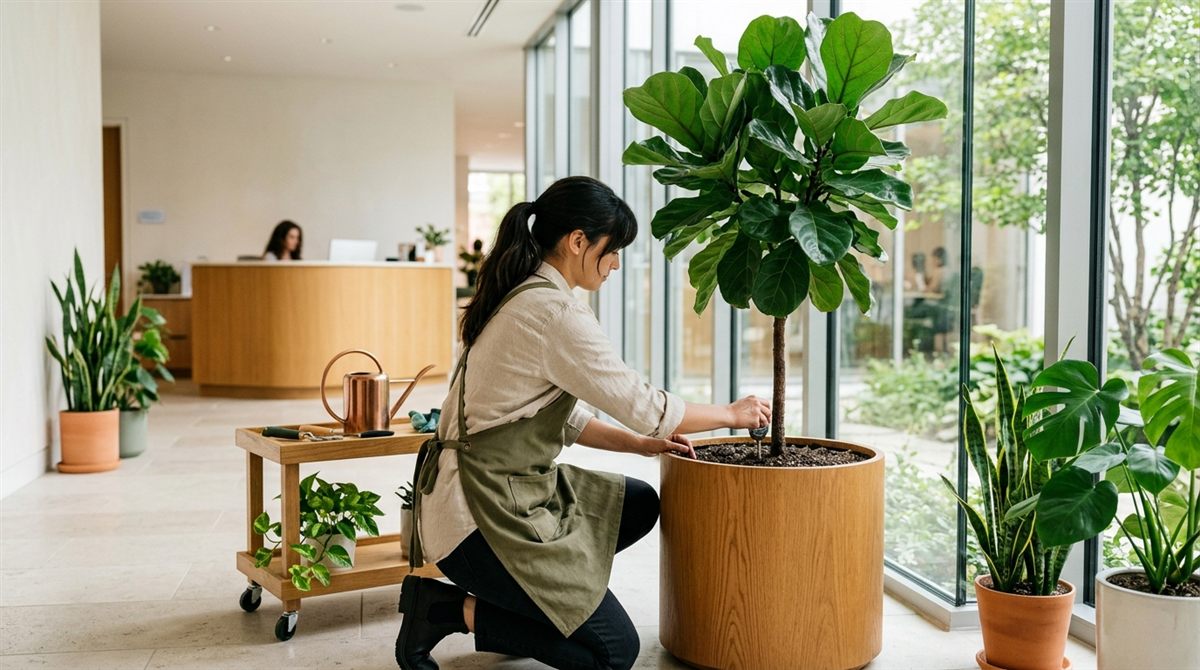

The fiddle-leaf fig by the east windows in a client’s reception has lost a third of its leaves since the last visit. If you replace it today, your company absorbs the cost, and if you bill the client instead, you need a reason they will accept. A plant replacement guarantee only turns into an argument when nobody wrote down what state the plant was in when you took it on and what changed around it.
The example is set in the United States, and it follows one public contract that spells out both cases, the plants the company replaces and the ones the client pays for. In October 2023 one US city invited bids for the care of the plants in one of its office buildings. Its terms are one buyer’s choices, not a law, but they show what a client will accept as a reason and what you need on record before you bill for it. Other clients write other terms, and a company in another country also works under that country’s own laws. The client with the fig is not a real business. Its reception, the fig and the record further down are an example built for this guide.
The short answer: Who pays is whatever your agreement says, so write down where your plant replacement guarantee stops before anything dies. In the city contract this guide follows, a plant that declines under normal care is replaced at the company’s cost, and the client pays when the building or its people caused the loss, from watering by the client’s own staff to a new partition that cuts off the light. A bill on those grounds only holds if the plant’s condition when you took it on and the change to the building are on a dated record, so check both before you send the invoice.
What the plant replacement guarantee covers at your company’s cost
Under the city’s terms, replacing plants that deteriorate is part of the service. The company visits every seven to ten days, or more often if needed. When a plant’s appearance or quality calls for a replacement, the company replaces it at its own expense, at no extra cost to the city. Both sides judge that need together, “acting reasonably”. The terms set no deadline for the replacement itself.
The company may also swap a plant for another species “of the same value, size and height”. So a fig that keeps failing by a drafty door can become a sturdier plant of the same stature, without a new negotiation. Under terms like these, a plant that declines under normal care is your cost, because the price of the visits already pays for its replacement.
When the client pays instead
The same contract then lists the causes for which the city pays, if it chooses to replace the plant at all. Each one is something the building or its people did, not something the care missed. Each one also needs evidence, because the client will ask how you know.
| Cause the city’s contract lists | What to have on record |
|---|---|
| Watering by the client’s staff, visitors or other firms on site | Soil far wetter than your schedule allows, the date, and who said they watered it |
| Damage to plants or containers by those same people | A dated photo and a short description |
| Long or extreme heat or cold after the building’s HVAC stops (the contract says rooms stay between 50 and 85 °F) | Your temperature reading and the outage dates from the building |
| Theft | The date you found the gap and the date you told the client |
| Light reduced below its level when the contract began | The light noted at the start, the change (a partition, new blinds) and its date |
| A plant moved from its starting place without your approval | Where you found it and where the inventory places it |
| Liquids or substances in the soil or on the plant: cleaning chemicals, alcohol, coffee, tea, soda, sugary drinks, toxic gases | What you saw or smelled, and a photo of the soil surface |
| No hot and cold running water in the maintenance closet on each floor | The visits when you could not get water, and on which floor |
Notice the light clause. It compares today’s light with the light “at the time of Agreement commencement”. You can only use it if someone noted the light at the start. The same goes for heat and cold, which need a reading, not a feeling.
Months later, the starting inventory settles who pays
The city’s contract asks for a complete list of the existing plants, their location and their condition within 30 days of the start of the agreement. That list is the evidence for every later decision. A ficus listed as “thin, lower leaves dropping” on day one is a different case from one listed as “full canopy”. The first was already declining when you took over the account. The second was fine until something changed.
So walk the site with the facilities manager and write it down plant by plant. Add a photo of each display. Note the light at each spot in words the client will recognize: “north window, blinds open”, or “interior, ceiling lights only”. If you carry a light meter, add the reading.
What a complete replacement record looks like
Here is how one replacement decision looks when the record is complete. The clause is the city’s, and the dates and the price are the example’s.
| Field | Entry (example) |
|---|---|
| Plant | Fiddle-leaf fig (Ficus lyrata), 7 ft, reception, east glazing |
| Starting inventory, Mar 2, 2026 | Good: full canopy. East window, blinds open, bright until early afternoon |
| Visit, Sep 15 | Client has installed a glass and timber partition between the window and the plant |
| Visit, Sep 22 | Light now from the ceiling only. Two lower leaves yellow. Soil moist, on schedule |
| Visit, Oct 6 | About a third of the leaves dropped. No pests, watering on schedule |
| Cause | Light reduced below its level at the start of the agreement |
| Decision | Client pays. Offered: a ZZ plant of the same size, which tolerates low light |
| Client approval | Facilities manager, by email, Oct 8 |
| Cost | Plant $360 + installation $60 = $420 |
| Installed | Oct 13; fig taken back to the company’s recovery stock |
Each line answers a question the facilities manager will ask. Was it fine before? Yes, the March inventory says so. What changed? The client put up a partition, and the visit notes give the date. Did you keep caring for it? The record shows every watering on schedule. That is why the bill holds.
Agree with each client which losses they pay for
The city’s list works because it was agreed before anything died. Contract terms differ from client to client, and so do the laws behind them, and your company remains responsible for what its own agreements say. So put a similar list in your own agreement, in words your clients use, and read it again before you send an invoice. Ask clients to tell you before they move plants, fit out a floor or switch off the heating for a holiday. Then you hear about a change in the building from a note, not from a fig that has lost its leaves.
The reception fig went back to the recovery stock on October 13. A ZZ plant of the same height now stands behind the new partition, under the ceiling lights it can live with. The $420 invoice sits on the same record as the facilities manager’s email.
BEFORE THE INVOICE GOES OUT
A bill for a replacement plant holds up when the record shows the cause.
The argument over the reception fig ended on what the record showed: the state the plant was in at the start, and the partition that took its light. FolioGreen was built to keep every plant on record, with care visits, rotations and replacements and the reason behind each.
Sources and references
- City of Tulsa, “Invitation for Bid TAC 875B: Maintenance of Indoor House Plants OTC”, October 6, 2023. cityoftulsa.org